
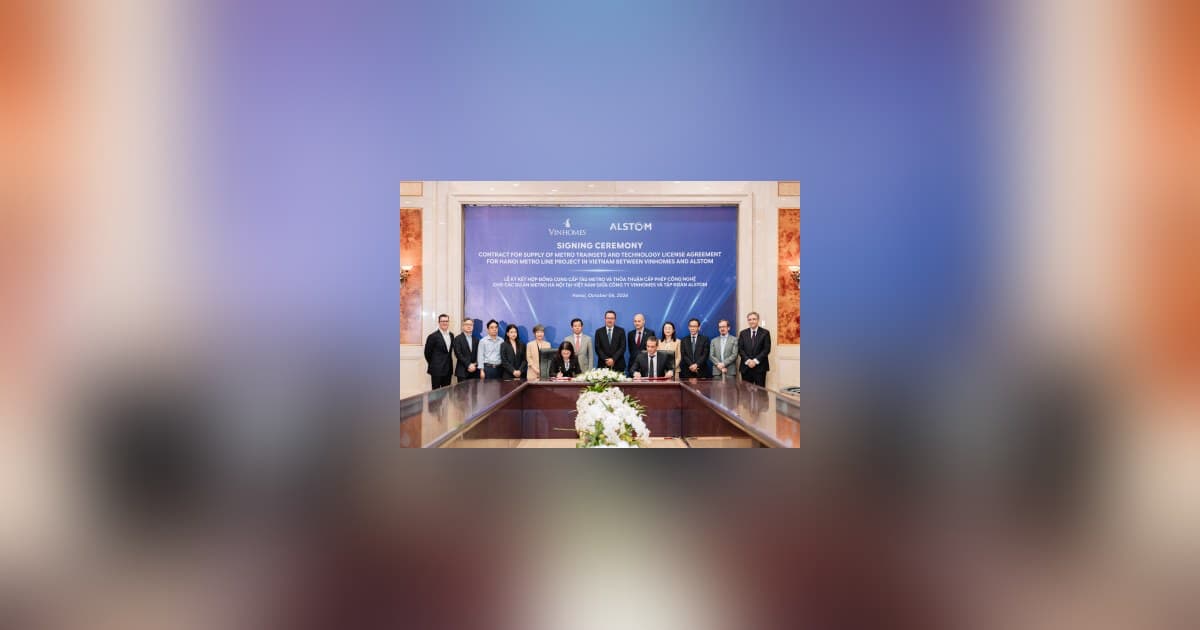
Vingroup and Alstom, a global leader in rail technology, have signed a rolling stock contract and a Technology License Agreement (TLA) that will see Alstom transfer technology for train manufacturing and assembly in Vietnam while supplying 200 Metropolis trainsets to accelerate Hanoi's urban rail projects. The agreement, announced via Media OutReach Newswire, marks a significant step in Vietnam's efforts to modernize its rail infrastructure and build local industrial capacity.
Under the contract, all trains designed and manufactured by Alstom for Hanoi's urban rail lines will be new-generation five-car trainsets offering advanced features in design, operational efficiency, and safety. The aluminium car body reduces axle load, saving energy and reducing track wear, while the wide-body design maximizes interior space and increases passenger capacity. The trains will run fully automated and driverless at GoA4, the highest grade of automation. A modern braking system combines regenerative and disc brakes, ensuring safety while recovering energy during braking.
The first 83 trainsets will be designed and manufactured at Alstom's Valenciennes Petite-Forêt site in France, one of Alstom's centres of expertise for metros. In addition to supplying these complete trainsets, Alstom will provide technology, engineering expertise, tooling support, and key components, enabling Vingroup to develop local capabilities to manufacture and assemble the next 117 trainsets in Vietnam. This phased approach is designed to strengthen Vietnam's self-reliance and modernize its rail industry ecosystem, opening opportunities for a long-term industrial partnership and progressively expanding Vietnam's participation in the global value chain.
Mr. Martin Sion, Alstom CEO, said: "This agreement is a major milestone for Alstom in one of the fastest-growing mobility markets in the world. By combining Alstom's global expertise with VINGROUP's industrial strength and long-term vision, we are creating a unique partnership that supports both the expansion of Hanoi's metro network and the development of local rail capabilities. This agreement also demonstrates the strength of French rail technology and reinforces Alstom's position as a trusted partner for major mobility projects across the region."
Mr. Nguyen Viet Quang, Vice Chairman and CEO of Vingroup, said: "High-speed rail, urban rail, bridges, ports, logistics and other next-generation transport infrastructure are among the key areas under Vingroup's Infrastructure pillar. Our strategy is to connect world-class international resources, technologies and expertise with the strong execution capabilities of Vingroup's ecosystem, enabling us to contribute to the development of infrastructure platforms with long-term significance for Hanoi and Vietnam."
Vingroup is the general contractor for Hanoi's metro projects through its subsidiary Vinhomes. The partnership with Alstom aims to provide rolling stock for Hanoi's urban rail projects while progressively developing local capabilities, enabling Vingroup to contribute over the long term to the development of the city's urban rail network. For more information on Vingroup, visit www.vingroup.net/en, and for Alstom, visit www.alstom.com.
Under Hanoi's Capital Master Plan with a 2045 vision, the city's urban rail network is planned to reach 979 kilometres, comprising 18 lines and serving as the backbone of the city's public transport system. With a total planned length of nearly 1,000 kilometres, the network would represent one of the largest urban rail development programmes in Southeast Asia, helping reduce traffic congestion, mitigate environmental pollution, and improve the quality of life for Hanoi's residents.
The implications of this agreement extend beyond Hanoi. For Vietnam, it signals a strategic move to develop a domestic rail manufacturing base, reducing dependence on imported rolling stock and fostering a skilled workforce. The technology transfer could catalyze the growth of a local supply chain, creating jobs and attracting further investment in high-tech industries. For Alstom, the deal solidifies its presence in Southeast Asia's rapidly expanding mobility market, positioning the company as a key player in one of the world's fastest-growing regions. For the global rail industry, the partnership exemplifies a trend of emerging economies leveraging international expertise to build self-reliant infrastructure, potentially reshaping supply chains and competition. As Hanoi's metro network expands, it could serve as a model for other Southeast Asian cities grappling with urbanization and congestion, demonstrating how public-private collaboration and technology licensing can accelerate sustainable transport solutions.
