
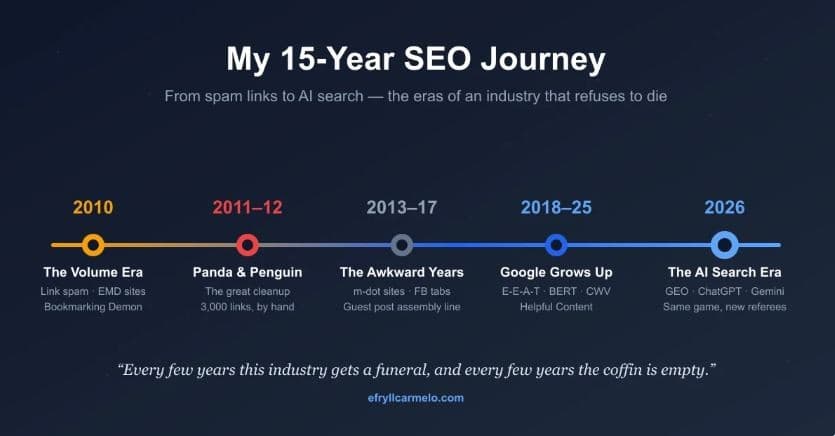
Efryll Carmelo, a senior SEO manager based in Iloilo City, Philippines, today published "My 15-Year SEO Journey: From Spam Links to AI Search," a retrospective on fifteen years inside the search industry. The piece documents how the discipline survived every algorithm crackdown that was predicted to end it, and why he argues the arrival of AI search is a beginning rather than an obituary.
The retrospective revisits the era of automated link-building software such as Bookmarking Demon and Market Samurai, which dominated search marketing in 2010. Carmelo describes building micro-niche websites on exact-match domains with thin content and Google ads, each earning twenty to fifty dollars a month. "At the time, that felt like a machine that would run forever," he noted.
The machine stopped in 2011 and 2012 when Google released the Panda and Penguin updates, targeting thin content and manipulative links. Carmelo recalls the manual cleanup required: "Imagine one website with three thousand backlinks that now had to come down. We emailed webmasters one by one asking them to remove links we had spent years building. Entire businesses disappeared from search results overnight."
From 2018 to 2025, Google's Medic update, BERT model, Helpful Content update, and spam policies shifted the focus to expertise, trustworthiness, and people-first writing. Guest posting, once the industry's replacement for link spam, was itself commoditized and policed.
Now, AI search is reshaping the landscape. Industry tracking studies in 2026 report that AI Overviews appear in roughly 25% of Google searches, and 58.5% of U.S. searches end without a click to any website. ChatGPT has reached approximately 900 million weekly active users. Carmelo details how traditional optimization is expanding into generative engine optimization, the practice of earning citations in AI-generated answers.
"Every few years this industry gets a funeral, and every few years the coffin is empty," Carmelo said. "Panda was supposed to kill SEO. Mobile was supposed to kill SEO. Now people say AI answers will kill it. What actually happens is the work gets renamed to answer engine optimization or generative engine optimization, and the fundamentals get stricter."
Carmelo argues the current moment favors newcomers. "In 2010 the barrier to entry was owning spam software. In 2026 it is curiosity. The platforms are new, the measurement is unsettled, and nobody has fifteen years of experience in AI search, because the field is only a few years old." He adds, "You survive on patience, because results are earned in months rather than days, and on a genuine love for the game, because the game refuses to stay the same."
