
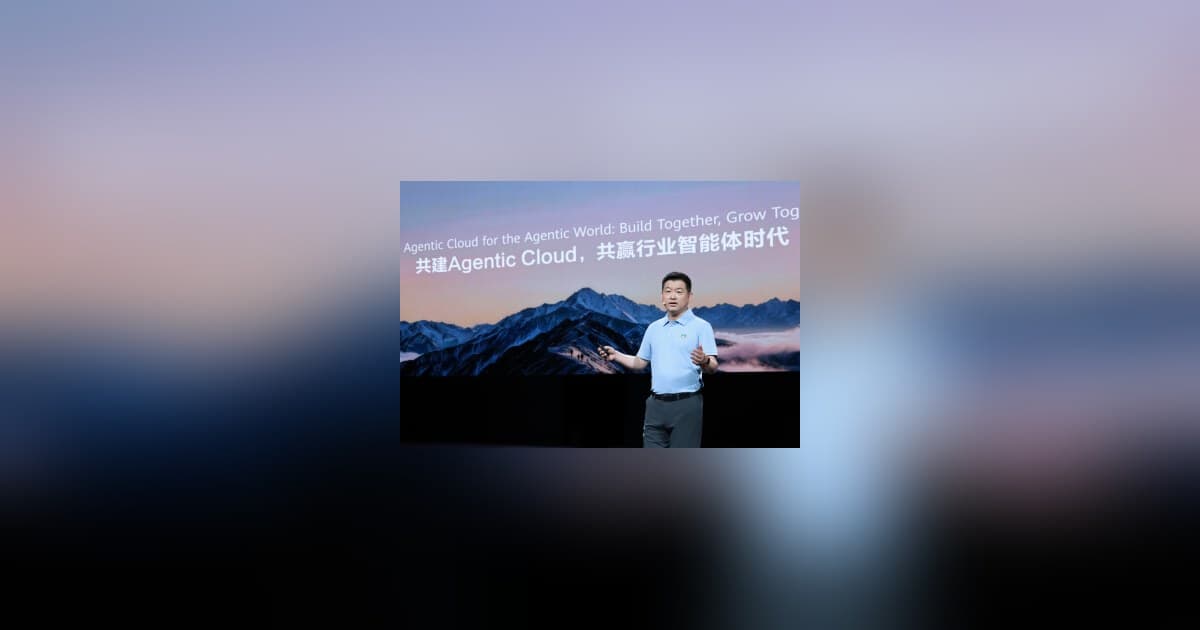
At HUAWEI CONNECT 2026 in Shanghai, Huawei Cloud announced a comprehensive suite of enterprise AI products designed to accelerate the adoption of agentic AI across industries. Dr. Peter Zhou, Director of the Board at Huawei and CEO of Huawei Cloud, delivered a keynote titled "The Agentic Cloud for the Agentic World: Build Together, Grow Together," outlining the company's strategy to strengthen its cloud infrastructure and platform services for AI agents.
Central to the announcement is the latest AI Cluster Service (AICS), which is built on a five-level fast recovery mechanism with full-chain observability. It supports over 40 days of stable training on cloud and can recover from faults within 10 minutes. With coordinated optimization across scheduling, cache, and algorithms, AICS delivers 20% higher token throughput than the previous generation. The service will be commercially available in China on September 30 and in markets outside China on November 30.
Huawei Cloud also introduced the Context Memory Storage (CMS) solution, addressing the memory capacity and access efficiency needs of long-horizon agent tasks. CMS provides a petabyte-scale memory space, twice the storage capacity of comparable industry products, and supports high-speed terabyte-scale memory reads with 50% higher performance than industry peers.
The Agentic Model as a Service (MaaS) platform brings together diverse models, enabling developers to invoke state-of-the-art models from leading providers with just one click and no deployment required. At the event, MiniMax demonstrated its advanced multimodal model, which, combined with Huawei Cloud, delivers open, cutting-edge multimodal capabilities.
Huawei Cloud is advancing its enterprise-grade agent platform through a dual approach: commercial and open source. Built on AgentArts and its open-source edition openJiuwen, the platform opens up more than 5,000 general Model Context Protocol (MCP) assets and over 1,000 industry-specific MCP assets. To date, the platform has served more than 100 customers, including the Shenzhen Longgang District Government, China Southern Power Grid, Guangzhou Laboratory, the University of Science and Technology of China, Kingsoft Office, Sichuan Yingu Carbon Sink Renewable Resources Co., Ltd., Changsha Thunder Cloud Network Technology Co., Ltd., and KingMed Diagnostics. AgentArts will be commercially available in markets outside China on December 30. The openJiuwen open-source community has surpassed 50,000 stars and 3.29 million downloads.
The Industry AI Foundry has accumulated more than 1,000 industry assets, with over 1,000 projects deployed. It now includes two new zones: Smart Government Zone and AI Hardware Zone. The Smart Government Zone has already brought together 24 founding partners, covering scenarios such as government office operations, public services, urban governance, and industry development. The AI Hardware Zone has onboarded 15 core partners, covering more than 20 device types, including AI glasses, AI toys, and AI recording cards, along with over 10 scenario templates and more than 110 scenario skills.
These developments could have significant implications for businesses in Long Beach, California, and surrounding areas. As AI adoption accelerates, local enterprises may gain access to advanced tools for building and deploying AI agents, potentially enhancing efficiency and innovation. The open ecosystem and partner editions, launched with Chinasoft International, iSoftStone Group, and Beiming Software, offer opportunities for regional tech companies to collaborate and expand their reach. The global availability of these services underscores the growing importance of AI in driving economic growth and competitiveness. For more information, visit HUAWEI CONNECT 2026.
