
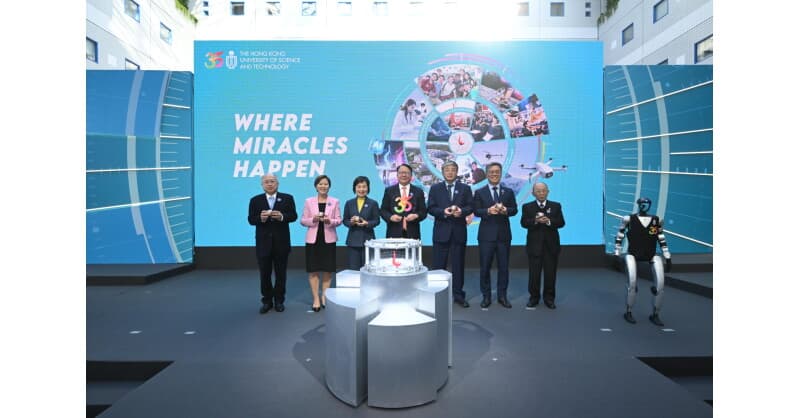
The Hong Kong University of Science and Technology (HKUST) officially launched its 35th anniversary celebrations on March 16, 2026, with a ceremony themed "Where Miracles Happen" that brought together government officials, industry leaders, and the university community. The event marked a milestone for the institution, which has risen to rank among the world's top 50 universities since its founding in 1991.
President Prof. Nancy Ip, who joined HKUST in 1993, reflected on the university's transformation into a world-class institution built on academic excellence and a vibrant innovation ecosystem. She credited Founding President Prof. Chia-Wei Woo for his foresight in establishing Hong Kong's first research-intensive university, long before the Greater Bay Area concept existed. "Their courage, dedication, and tenacity built the unshakeable foundation on which we stand today," Ip said.
A key highlight of the anniversary is the establishment of a new School of Medicine, which Ip described as "a transformative milestone, fulfilling a dream pursued for over three decades." The HKSAR Government has appointed HKUST to build Hong Kong's third medical school, which will bridge traditional medical curriculum with the latest technology and AI breakthroughs. The school is expected to admit its first cohort in 2028 and aims to revolutionize healthcare from diagnosis to treatment and personalized medicine.
The ceremony showcased HKUST's technological leadership through robotic demonstrations. A robotic lion dance from the Guangzhou campus team blended tradition with innovation, while robotic dogs developed by Direct Drive Technology, an HKUST-nurtured startup, carried ceremonial "Miracle Balls" to officiating guests. A drone donated by distinguished alumnus Mr. Wang Tao, Founder of DJI, delivered the commemorative "35th Symbol Key" to signal the inauguration of the anniversary celebrations.
HKUST's national contributions were also highlighted. The university has secured approval from the Ministry of Science and Technology to establish a new State Key Laboratory, strengthening its role in advancing cutting-edge research critical to national development. In space exploration, HKUST is developing a multi-functional robot for the historic Chang'E-8 lunar mission and leading the development of a high-precision greenhouse gas detection instrument set to become HKSAR's first payload to China's Tiangong Space Station.
Council Chairman Prof. Harry Shum emphasized the university's readiness for the future. "If we are to serve the next generation as well as we have served the past, we must lead, we must innovate, and we must redefine what education can be," he said. A year of celebratory events is planned, including co-hosting the THE Asia Universities Summit 2026 with Times Higher Education, an AI Film Festival, and joint celebrations with HKUST (Guangzhou).
Since its founding, HKUST has founded over 1,900 active start-ups, including 10 unicorns and 21 exits. Its graduates are consistently ranked among the world's top 30 most sought-after employees. The university's enduring legacy, symbolized by the "Circle of Time" visual theme inspired by the iconic Sundial sculpture, continues to drive progress in education, research, and knowledge transfer.
