
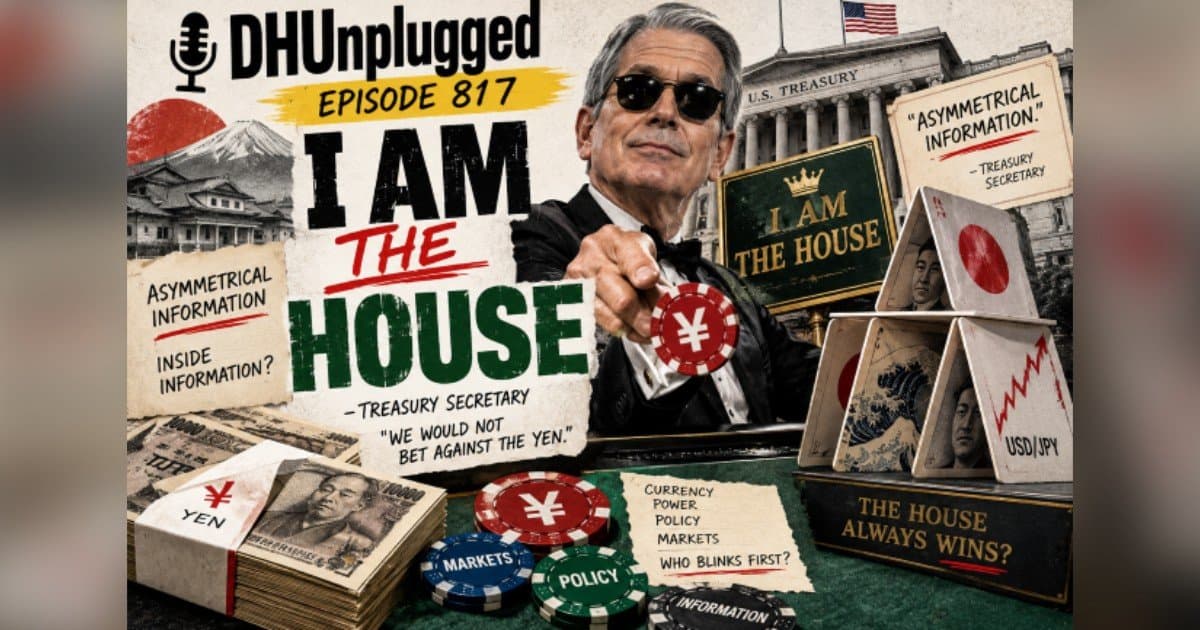
In a week marked by a post-Labor Day selloff and a Dow dropping over 600 points, Treasury Secretary Bessent's declaration that he is 'the house' has sent shockwaves through financial markets, prompting a heated debate about the government's role in currency and bond markets. The comments, made public on this week's episode of DH Unplugged, have been interpreted by analysts as a stark acknowledgment that policymakers now trade with an edge, a shift that could have lasting implications for market dynamics and investor confidence.
Andrew Horowitz and JC Dvorak, hosts of the weekly investing podcast, dissected Bessent's remarks, which were made in the context of the Japanese yen. 'His way of putting this is, I have an edge. And he even said, because I have the information, I have the inside information about what Japan is doing, therefore when I say something, it's not going to be speculative. It's going to be absolute,' Horowitz recounted on Episode 817, titled 'I Am the House.' Dvorak placed the comment in historical perspective, arguing that since 2008, the government has increasingly behaved like the Roman Senate before Caesar, and that the Trump era made this dynamic impossible to ignore.
The episode, released on September 8, 2026, comes at a critical juncture for markets. With a pivotal Consumer Price Index (CPI) print due on Friday, strategists are calling it the ultimate credibility test for the Federal Reserve. The hosts also highlighted a stalled Strait of Hormuz, where AIS trackers show a dead-quiet waterway, and Goldman Sachs' $120 per barrel oil target, adding to concerns about inflation and energy costs.
Bond yields have been climbing despite an economy running hot, a paradox that Horowitz and Dvorak explored. Horowitz noted that his firm is buying only short-duration Treasuries, citing the crush of new issuance from Washington and from data center operators tapping capital markets globally. This comes against a backdrop of a $40 trillion debt, raising questions about the sustainability of current fiscal policies.
The episode also covered Meta's roughly $18 billion multi-state settlement over youth safety guardrails and NVIDIA's reported $13 billion acquisition of Hugging Face, a deal that JC had called a week early. 'I was one week early, but I called it,' Dvorak said, referring to his earlier prediction. Other topics included Shein's downsized Hong Kong IPO, Nike's exit from the S&P 500, and a 162,000 payrolls print.
The hosts' skeptical tone was on full display as they connected these stories to broader market trends. They discussed the addition of Bloom Energy to the S&P 500 and sympathy rallies in Oklo and SMR, as well as strength in Intel, AMD, and SK Hynix ahead of Broadcom earnings. They also touched on Good Good Golf's Callaway ad backlash and Argentina beef imports.
For investors, the implications are profound. Bessent's comments suggest that the Treasury is willing to use its informational advantage to influence markets, which could lead to increased volatility and a reassessment of risk. The combination of potential oil shocks, rising yields, and a critical inflation report creates an environment of uncertainty. As Horowitz and Dvorak emphasized, the era of 'the house' may mean that retail investors are playing a different game entirely.
With the CPI print looming and geopolitical tensions simmering, the coming days will test whether the Federal Reserve can maintain credibility in the face of these multifaceted challenges. The full episode, available at DH Unplugged, offers a comprehensive look at the week's market-moving events.
